Bún chả
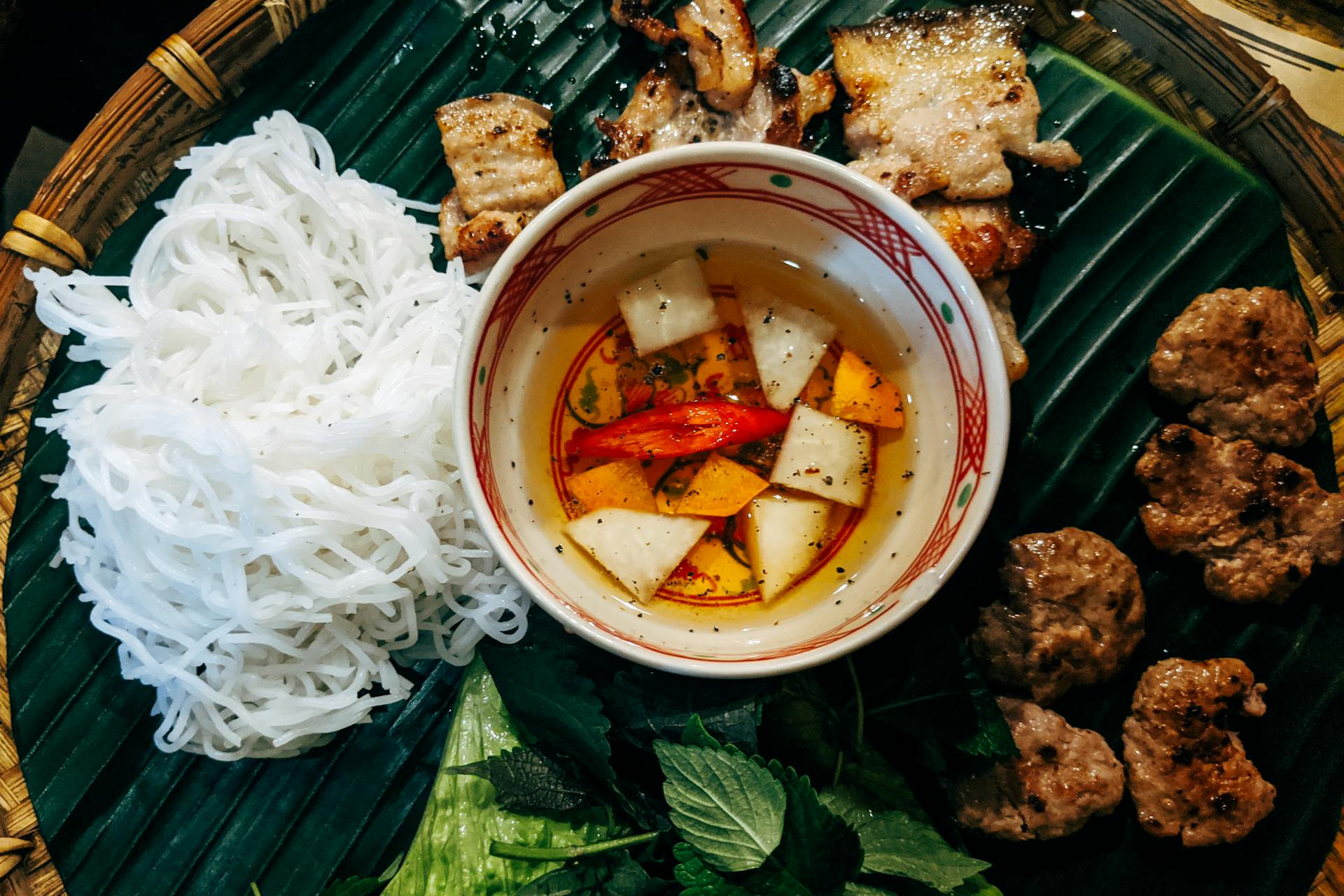
Marrying smoky charred pork with fresh vermicelli, Bún chả is the quintessential lunchtime experience of the Vietnamese capital.
Meaning
'Bún' are the fresh rice noodles, and 'chả' refers to the two types of grilled pork: minced patties and marinated belly slices.
Origin
Born in the narrow alleyways of Hà Nội, this dish reflects the Northern preference for subtle, savory flavors. It gained world fame in 2016 when Obama and Bourdain shared a meal on plastic stools.
Cultural Significance
In Hà Nội, Bún chả is strictly a lunch dish. The intoxicating smell of pork grilling over charcoal right before noon is the unofficial signal for the city's lunch break.
PRACTICE: Bún
The Vietnamese 'b' is close to the English 'b' in words like "boy" or "best," but not exactly the same. Press your lips together firmly, and as you release the sound, make it deeper and heavier in your throat — almost like you're gently swallowing the sound.
Combine a long 'oo' sound as in 'moon' with a clear 'n' sound at the end
To master this rising tone, start at a medium pitch and quickly slide your voice upward, just as you would when asking a surprised or urgent question like "What?" or "Huh?".
PRACTICE: chả
Press the middle of your tongue against the roof of your mouth for a 'ch' sound, keeping it 'dry' with no puff of air.
Open your mouth wide to make a clear "ah" sound, similar to the "a" in "father" or the sound you make when a doctor asks you to say "ah."
Start at a medium pitch, let your voice drop down low, and then quickly flick it back up at the very end, just like when you say "Really?" or "Huh?" in a tone of surprise or questioning.
EXAMPLES
Bạn muốn ăn bún chả không?
Do you want to eat bún chả?
Bún chả Hà Nội rất ngon.
Hanoi bún chả is delicious.
WHAT TO AVOID
English speakers often pronounce 'Bún' like the bread 'bun', but it should always have a long 'oo' sound. Another common error is saying 'chả' with a flat tone like 'cha-cha', forgetting the dipping and rising pitch that gives the word its meaning.